Summary: AI-produced training for franchise networks — brand resolution, food temperature control, opening procedures, allergen compliance, and product launch briefings. Multi-location, multilingual, SCORM-ready. Consistent brand-standard delivery across every franchisee in 10 business days.
Franchise Systems
One network. One operating standard.
Turn brand standards, allergen controls, launch playbooks and inspection requirements into consistent training every location can deliver, track and refresh.
Built for:VP of Franchise OperationsFranchise Development DirectorBrand Standards Director
200+ locations
Simultaneous deployment
10 business days
Delivery guarantee
Consistency snapshot
How much does managing inconsistency across your network already cost?
Use your own network data to estimate time spent correcting inconsistent delivery. Treat the result as a planning estimate, not a guaranteed saving.
30
2
Cost per field visit (travel + staff time)
Annual verification cost
$67,200
checking consistency that training should have built
Module cost
$5,000
one-time · 10 business days
Payback period
1 month
then saves every year after
30 locations × 2 field visits/quarter × 4 quarters = 240 visits per year — each one spent verifying consistency that a standardised training module would have built before the first visit. At $280/visit (travel + staff time), that's $67,200/year checking whether the standard held.
If you're reviewing mystery shopper data and finding a spread you can't explain with foot traffic, local market conditions, or management quality — it is usually training lineage. Someone trained someone who trained someone else, and by generation three the reasoning behind each SOP step has been quietly dropped. The steps are still there. The standard is not.
3–5×Weekly support calls from new franchisees in their first 90 days — field support time your network is already absorbing before a single mystery shop has been taken
22 ptsMystery shop gap between two locations of the same brand serving the same product on the same day — entirely a training delivery consistency problem
Month 8When brand standard degradation from informal training handoffs first appears in mystery shop data — months after the root cause began
Figures without a cited source are illustrative examples, not verified industry benchmarks — validate against your own network data.
Illustrative consistency pattern
The shift manager was trained — just not to the current network standard
Tuesday morning
A health inspector walks into a franchise location unannounced. The franchisee is at her other location. The shift manager has been with the business for four months.
The inspection
She doesn't know where the temperature logs from last week are. She can't locate the cleaning schedule. She knows the allergen information for most products but isn't certain about the new limited-time item that launched last month.
The report
The inspection report cites documentation failures and an allergen awareness gap. The franchisee receives the report and is furious — not at the shift manager, but at herself, because she didn't ensure the shift manager was trained to handle an inspection without her present.
The record
The franchise brand's inspection compliance data now has a blemish that affects their aggregate score. The shift manager had been trained — in the sense that information had been shared with her. She hadn't been trained to operate independently under inspection conditions. Those are different things.
Allergen awareness gap
Inspection report cites documentation failures
The network exposure
Where a standard degrades as it passes from one location to the next
Review the chain from informal handoff to mystery-shop variance, inspection findings and brand risk. Figures below are an illustrative example, not audited network data — validate against your own reporting.
30%
locations missed launch
locations that underdelivered on a new product launch via email-cascade model
18 pts
mystery shop gap
below-network score at Location 5 after 6 weeks no field visit
6 wks
retention window
when 60% of procedural knowledge has degraded without reinforcement
400 pp
ops manual
signed once at due diligence. A signed receipt is not training evidence.
Training cascade gapCompliance exposure
The difference
Give every location the same instruction, practice and evidence.
When training delivery depends on who trained whom
Franchisee receives training, trains first team
First team trains the next cohort — shorter sessions, less context
By generation three, steps are present but reasoning is gone
Mystery shop scores drift at month eight
Investigation finds a training lineage problem, not a will problem
vs
When every staff member trains from the same source
Every staff member receives training from the same source
The reasoning behind each SOP step is preserved across every location
Compliance records show who completed what, when, and at what score
New product launches deploy to every team member simultaneously
Brand standard is measurable — not an observation from a field visit
Managed training for franchise systems
Maintain one operating standard across every franchisee, location and employee group.
We can plan the training calendar, produce the courses, publish them to your LMS, assign learners, report completion and keep the material current as requirements change.
This programme is illustrative. Priorities, learner groups, delivery dates and reporting are agreed from your actual operating requirements.
Sample module
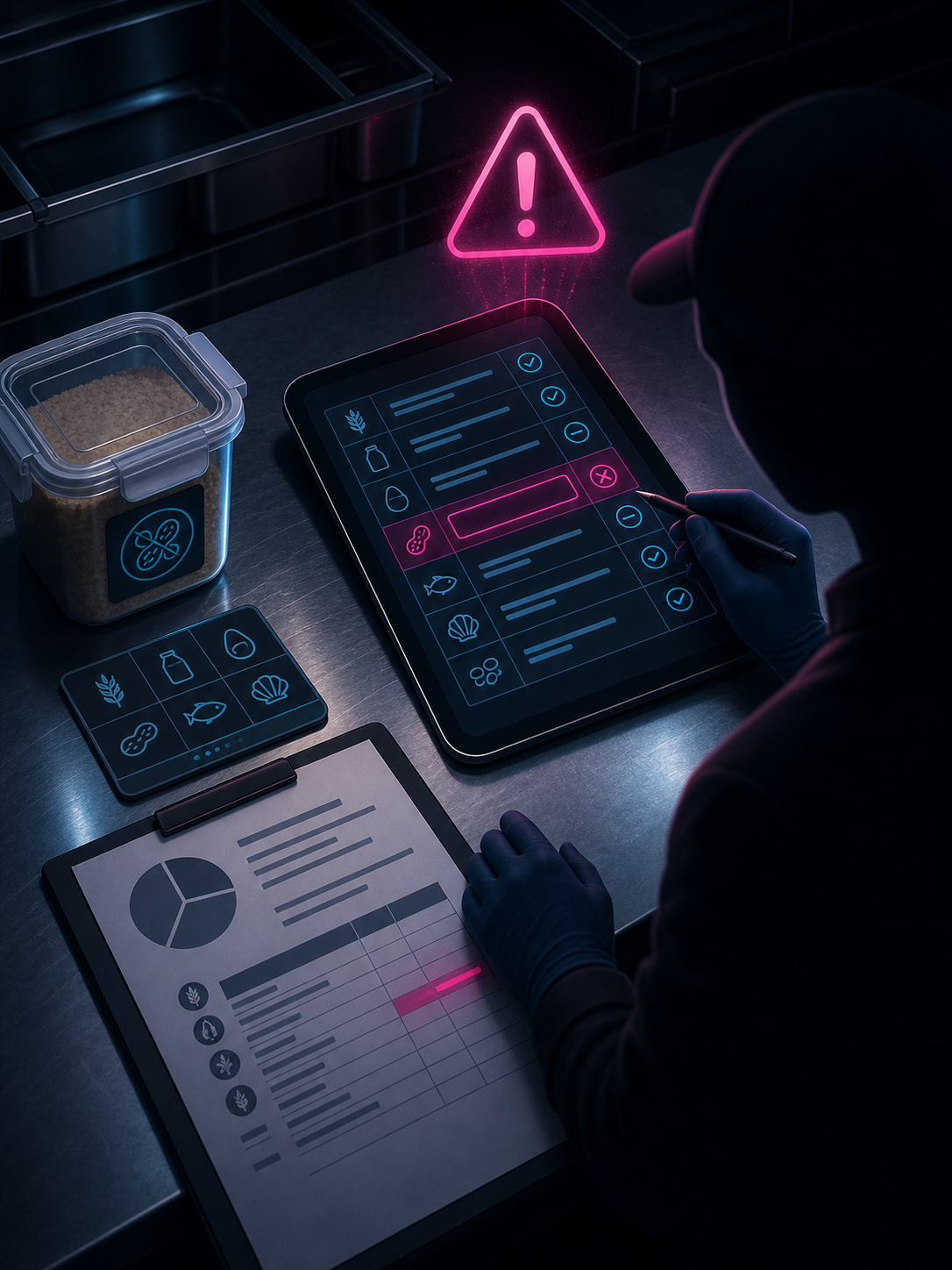
Allergen Awareness: The 14 Declared Allergens and Your Role
The compliance knowledge gap that appears most frequently in health inspections — and that informal handoff training consistently fails to close.
CA
0–3 minConcept Animation
HS
3–6 minHotspot Explorer
BS
6–11 minBranching Scenario
AQ
11–14 minAssessment
DB
14–15 minDebrief
15 minutes
SCORM 1.2 or 2004
Scenario-based assessment
0–3 min
Concept Animation
The 14 declared allergens under Regulation (EU) No 1169/2011 and Natasha's Law in the UK — what each is, the most commonly misidentified, and the legal obligation on food service staff. Built to your brand's regulatory jurisdiction.
3–6 min
Hotspot Explorer
Your brand's actual allergen matrix on screen. Learner identifies which products contain each of four specified allergens by clicking product cells. This is your menu, your data — not generic placeholder content.
6–11 min
Branching Scenario
A customer asks "Does your [product] contain nuts?" Learner navigates the enquiry — checking the correct source, giving the correct response, handling the follow-up "I have a severe allergy, is it safe?" Wrong path: incorrect assurance given, consequence scene shows the brand's legal exposure.
11–14 min
Assessment
Four allergen identification questions using real product descriptions from your menu. Completion is recorded with a timestamp and score — the evidence layer that a verbal team briefing cannot produce.
14–15 min
Debrief
The one answer you are never allowed to give on an allergen enquiry — and exactly what to say instead. A protocol your staff can recall under pressure, without the franchisee present.
Discuss this training gap
Or brief us on a different compliance or brand standard problem — we build to your specific menu, operations manual, and regulatory requirements
Priority network use cases
Build from the variance your reports already reveal.
Use mystery-shop gaps, inspection findings, launch errors and complaint themes to prioritise the next module across the network.
A franchisee trains her first team well — but by the third generation of staff, the SOP reasoning has been lost
Handling a Customer Complaint: The Brand Resolution Framework
Test one network standard before scaling the library.
Use your own allergen matrix, operations manual, complaint framework or launch brief. We confirm the audience, reviewer, evidence and deployment path before production.
One module · up to 30 minutes
Built to your brand's actual product range and compliance requirements
Scenario-based assessment — not a policy recall quiz
SCORM 1.2 or SCORM 2004 (your choice)
Deployable to all locations simultaneously via hosted learner link
Can you deploy training to 200 franchise locations simultaneously?+
Yes. We build the module once and it deploys to every location through a hosted learner link or via your existing LMS system using SCORM 1.2 or 2004 export. Every location receives the same module, not a version filtered through a field team cascade.
What if different locations have different configurations — menus, operating hours, regional compliance?+
We build location-specific variants from the same core module structure. The compliance requirements, brand standards, and core process remain consistent — location-specific details are templated in. This is significantly faster and cheaper than building separate modules from scratch for each variant.
How does this work for allergen compliance specifically?+
We build allergen awareness training directly to your product range and allergen matrix. The hotspot interactions and branching scenarios use your actual menu and your brand's allergen documentation — not generic placeholder content. Staff train against the real enquiry scenarios they'll face.
What proof does this provide that staff were trained — for inspections or compliance disputes?+
Every completion generates a timestamped record: who completed it, when, which version they trained on, and their assessment score. These records are held in your system (via SCORM LMS reporting) or through our hosted learner link dashboard. In a compliance dispute, this is the evidence layer a signed attendance sheet cannot provide.
Tell us where the network standard is drifting.
Share the mystery-shop gap, inspection finding, launch error or recurring complaint. We will confirm the learner behaviour and best production path.
Necessary storage keeps your privacy choice. With your permission, analytics helps us understand which pages are useful. We do not enable advertising cookies. See our Privacy Policy.